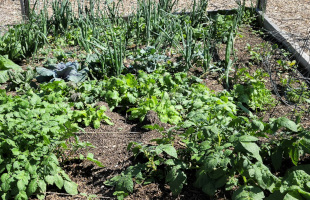
fallwth6d Thanksgiving as a Harvest FestivalIn the United Sates of America, today is set aside as a day of thanksgiving.  From our legends about why this is so, you can see that Thanksgiving is a harvest festival under a different name.  We celebrate the thanksgiving of the first European colonists we acknowledge when they harvested their crops and finally had something to eat.

Harvest festivals are common in agrarian societies all over the world.  While winter has always been hard, the time just before harvest is hard too.  Most of the stores are gone, game is wary, and things are lean.  The harvest, while hard work, means survival for another year.  Conversely, if the harvest fails, starvation looms.

This year, with droughts, earthquakes, tsunamis, and fires, the harvest is less than usual.  Expect to pay more for both meat and vegetables for two or three years to come because of the weather.  Ranchers have sold off herds of beef cattle because the hay crop failed and they cannot feed them.  That means that beef is was cheaper this summer, when cattle flooded the market, but is already becoming more expensive.  Since many of those cattle were breeding cattle, this rise in price will continue for the two to three years it takes to rebuild herds, assuming we get some rain.

Wheat, corn, and other crops either didn’t make or made poorly, as well.  Again, the drought that spread over most of the United States and Canada is to blame.  Prices will continue to rise until the spring crops make, if we get rain.

What can you do to ensure your own personal harvest?  Grow a small (or large, if you are ambitious) garden.  Most places will allow potted plants, so you can grow one even if you live in an apartment.  If you have the water to irrigate the garden, you can have as much food as you need.  Potatoes, turnips, beets, carrots, parsnips, and radishes give you starch for energy.  Beans and legumes such as peas give you protein.  Onions, cucumbers, peppers, tomatoes, eggplants, and similar vegetables give you all the vitamins and nutrients you need.  Add a chicken coop for eggs and meat, or rabbits, and you can manage without buying more than flour, oil, baking powder, baking soda, and a few spices.

I am thankful to live in the country where I can raise my food.  I am thankful that I am able to help others do the same. I have been blessed with a family and good friends who love me.  I wish you a happy holiday season and many blessings.

Gardenbookfrontcoverthumbnail Thanksgiving as a Harvest Festival For more help gardening, buy my book, Preparing A Vegetable Garden From The Ground Up Thanksgiving as a Harvest Festival
Available in print or ebook from Amazon.com or other retailers, this book walks you from choosing the site of your garden all the way through what to do after the harvest. Buy a copy for yourself or a friend today!

{ 0 comments }

Grapes have become a popular plant to grow in our area.  With two wineries in Greenville, Landon Winery and the Blue Armadillo Winery, it is natural to assume grapes grow well here. Most areas in Hunt County are vulnerable to Pierce’s Disease, however, so while grapes may do okay for a couple of years, they then die off. [click to continue…]

{ 0 comments }

Remember the saying, “Give a man a fish, you feed him for a day.  Teach a man to fish, you feed him for a lifetime?”  Gardening is like that .  You can teach someone to garden, to grow their own vegetables, and they will have food security.  Even if they do not live anywhere that  has any place to plant, pots and a little ingenuity will make it work. [click to continue…]

{ 0 comments }

When I was growing up, the Friday after Thanksgiving was Christmas decoration day.  The Christmas tree and decorations went up in the living room.  Decorations went all over the house.  Just as important, though, was the writing of the Christmas cards.

These were hand addressed and something personalized was written for each person.  I remember the agony of trying to come up with ten or fifteen different ways to tell various relatives about my activities and interests over the last year. Writing the same thing for each person was strictly forbidden.

The nice thing about sending Christmas cards was receiving them.  As the season wore on, cards came in the mail addressed to me.  My cards were set out on my dresser, while cards sent to the family were displayed on the bookshelves in the family room.  I loved reading about the different things favorite relatives wrote.

Nowadays, not as many people send Christmas cards.  However, it is still nice to write a favorite person or two a personalized note wishing them the joy of the season.  Tiny prints has over 450 cards to chose from that you can personalize with a photo or many photos.  I like the 5 X 7 DIY Holiday card as I like the freedom to design a card no one else has.

1 Holiday Card Traditions at Lambda Farm

Tiny Prints provides simple, modern, and unique stationery from Christmas cardsNew Years cardsparty invitations, andaddress labels to thank you cards. Once the holidays have come and gone, Tiny Prints will still be here to fill your stationary needs with their exclusive designs from the nation’s top designers.  All year round, you’ll fine business cards,birth announcements and even custom wedding invitations. Come try the easy card personalization, a powerful preview engine and top-notch customer service and paper quality for yourself. With Tiny Prints by your side commemorating every holiday and momentous occasion is a cinch!

What are your holiday traditions?  What do you celebrate this time of year?

FTC Disclosure:  I was given a gift card for Tiny Prints products in exchange for this post.  I have worked with them before and enjoy their products.  My opinions are honest and  my own.

{ 0 comments }

The writer’s curse is, “Be Careful Or You Will End Up In My Next Book.”  This is similar to the mother’s curse,”I hope your children are just like you.”  Speaking of mothers, I am a guest on my mother’s blog, A Writer’s Life, discussing the writer’s curse today.  I hope you wander over and say hello.

Gardenbookfrontcoverthumbnail Guest Post on The Writers Curse For more help gardening, buy my book, Preparing A Vegetable Garden From The Ground Up Guest Post on The Writers Curse
Available in print or ebook from Amazon.com or other retailers, this book walks you from choosing the site of your garden all the way through what to do after the harvest. Buy a copy for yourself or a friend today!

{ 0 comments }

If your childhood was anything like mine, you know what the “look of death” meant.  Usually delivered when snatching me bald headed for some infraction was not desirable — out in public, or at a party, for example, it froze my blood and promised retribution later if I didn’t shape up.  Do bugs have this problem?  It turns out that they do, but it is from predators, not moms.

Researchers caught wild dragonfly larvae and put them in one of two tanks.  In one tank, there were predators of dragonfly larvae.  In the other, no predators.  The little larvae were in a transparent cage within the aquarium, so the predators couldn’t reach them.

After a few months, the researchers took a head count of the larvae.  The ones around the predators were two to four times more likely to die than the ones in predator free environments.  They were also less liklely to survive the metamorphosis into a dragonfly.

The researchers attributed this high mortality to stress. The larvae were afraid to make trips out of the rocks to eat, so were less healthy.  The smell and sight of the predators were a constant stressor. Some of the larvae just couldn’t hack it.

So, now my question is this:  Will it work with grasshoppers?

Shannon J. McCauley, Locke Rowe, and Marie-Josée Fortin, “The deadly effects of ‘nonlethal’ predators

Gardenbookfrontcoverthumbnail Can Stress Kill Bugs? For more help gardening, buy my book, Preparing A Vegetable Garden From The Ground Up Can Stress Kill Bugs?
Available in print or ebook from Amazon.com or other retailers, this book walks you from choosing the site of your garden all the way through what to do after the harvest. Buy a copy for yourself or a friend today!


{ 0 comments }

Carrots are rich in beta carotenes and are good for you.  It can be hard to get your kids to eat them,though.  Set aside a little space in the flower bed or garden that has full sun and let your kids grow their own carrots.  Studies have shown that kids are more likely to eat things they grow themselves.

For detailed instructions on how to plant carrots, see Growing Carrots.  Here is a snapshot of the information you need to choose what cultivar to plant.

when to plant: February 10 to March 1, August 1 to August 20
depth of planting:  1/2 inch
spacing of plants inside row: plant closely and thin to 2 inches apart after the carrots are 4inches tall.
spacing of rows: 3 inches
time to harvest: 62-75 days, depending on variety
fertilizing: work in one cup of 10-10-10 per 10ft of row before planting. When carrots are 4inchestall, side dress with 2 tablespoons of the same fertilizer.

cultivars for Hunt County:

VarietyDays to Harvest
Betasweet (purple)72
Denver half long75
Nantes half long70
Red Core Chantenay70
Scarlet Nantes70
Touchon (Heirloom)62
Processing 
Denver 12675
Gold King68


{ 0 comments }

Today I have a guest post by Terry Ford on gardening apps for your smartphone.  Please join me in welcoming her to Information Central.


If you have a garden and a smartphone, you’re in a great position for a good harvest! Just download a few different gardening apps, and your season will never be easier. Using a gardening app will help you to streamline the gardening process. You can keep track of everything for your garden in one place, and easily look up answers to any questions you have. Your crops or flowers will thank you for it! Here are some great gardening apps for you to try today. Download whichever ones you think will help you the most and best fit into your gardening style.


Garden Produce USA

With this app you can track all of your vegetables, fruits and herbs in one place. Add every crop you’re growing, including different varieties, and keep track of the date you planted them and how much you planted. You can mark if they were a success or not, and view a countdown of days until harvest time. You can add as many notes as you like to each crop, and even create a favorites list. There are other features as well, such as advice for soil preparation and ability to look up information on hundreds of plants. This app costs $4.99.


Landscaper’s Companion

This app is one of the foremost reference guides for any plant gardener. It contains information on thousands of trees, shrubs, annuals, perennials, and all types of plants. Plants are separated by type, and information includes water and sun requirements and sizes. There are thousands of pictures and you can even add your own and create a list of favorite plants. You can even read about some common uses for the plants and any problems you might encounter with them. The cost is $4.99.


Bugs and Insects

This app will help you identify all the bugs and insects that visit or feast on your garden. It has about 900 different bugs and insects, and you can read all about their characteristics. You can even save your “favorite” bug lists, and add your own notes to each bug. It costs $0.99.


Pocket Garden

This is another app to keep track of everything you’re growing in your garden and when it’s harvest time. You can also get information on many different types of seeds, and read suggestions on how to grow your plants. You can learn about planting depth, spacing, watering and more. This app costs $0.99.


Flower Pedia

If you are a flower gardener, this app help you identify and learn about almost 3000 different varieties of flowers. You can search for flowers in different areas of the country. You don’t need to be connected to the Internet to use this app. It will also let you share with your friends when you’ve spotted flowers on the go, and you can browse different places that others have found flowers in your community. It costs $4.99.


Gardening

This app will help the casually interested gardener learn about growing a vegetable garden. It will teach you how to plant and care for many different plants and vegetables, and lets you create a list of the ones you are interested in. You can track when your plants will be ready for harvest, and even create garden “to do” lists. This app costs $0.99.


Terry Ford from Grammarly grammar checker follows tech trends and loves to share with her readers.


Gardenbookfrontcoverthumbnail Six Great Apps For Gardeners For more help gardening, buy my book, Preparing A Vegetable Garden From The Ground Up Six Great Apps For Gardeners
Available in print or ebook from Amazon.com or other retailers, this book walks you from choosing the site of your garden all the way through what to do after the harvest. Buy a copy for yourself or a friend today!

{ 0 comments }

If you enjoy wildflowers, you can see some beautiful plants and learn some interesting facts in a PBS video that draws heavily on the knowledge of the Lady Bird Johnson Wildflower Center.  This video discusses the history of wildflowers and the way in which they were used.  The video is about an hour long and if you do not want to watch it online, you can order it in a DVD.

For those who do not know, Lady Bird Johnson worked tirelessly to beautify the landscape and encourage the use of native plants instead of exotics.  She was very much before her time in this regard.  Because of her, wildflower seeds are sown along major portions of interstate and state highways each year.  Mowing is delayed until after July 15th in Texas, so that the flowers have time to grow seed and drop them for the next year’s crop.

The landscape would look very different without Lady Bird Johnson’s tireless efforts.  She was truly a lady and a civilizing influence on LBJ.  You can find out more information on her on the Lady Bird Johnson Wildflower Center website.

{ 1 comment }

Texas, and much of North America, is in the worst drought since records have been kept.  Many people have asked what they need to do to keep their trees alive,  The Texas Forest Service has a very helpful video with information on how much and how often to water your trees to keep them alive.  Here it is:

Hopefully this will answer your questions on watering trees.  The Texas Forest Service has a lot of good information on their website, so take a look if you have more questions.

{ 0 comments }

In honor of Halloween, I am presenting to you a list of the top ten scary creepy crawlers and flyers in North America.  This is simply my opinion, and your mileage may differ, but these are the bugs that make this bug geek squeak:

10. Wasps–Anyone who has ever dislodged a wasp nest when clearing brush or mowing knows how bad these insects can hurt and how sick the stings can make you.  People who are allergic to the venom can die from a single sting.

9. Black widow spider– These are bad news if they bite you, but for the most part they will leave you alone if you leave them alone.  I had an infestation in my tack shed one year and my Dad had to poison them.  Getting my saddles and tack got a bit sporty there for a while.

8. Brown recluse spider — the other poisonous spider in North America.  Most brown spiders are harmless, but the fiddle on his back gives this one away.  Most homes have them and they never cause a problem, but be careful reaching into dark places.

7. Fire ants — need I say more?  They sting as a horde, and the venom can kill if you get enough stings.  They kill wildlife and make picnics miserable.

6. Ticks — carry scary diseases like Rocky Mountain Spotted Fever, Lyme’s disease, and others.  Even if they didn’t do that, the whole suck your blood thing doesn’t work for me or my dogs.

5. Bed bugs — when I was a child my mother would say, “Sleep tight, and don’t let the bed bugs bite.”  It was a joke then, a saying left over from her childhood when bed bugs would make life miserable.  Well, their baaack, and they are showing resistance to pesticides that mean they are very hard to control.

4. Lice — also make life miserable and are also becoming pesticide resistant.  Schools battle this problem constantly and they are losing more and more.

3. Flies — some bite, others do not bite humans.  They buzz, though, and walk across food and in cups without washing their feet.  They also walk across less delicate items, so track that on your food.  Ick!

2. Fleas — before modern flea control products, flea bite anemia was common in puppies and kittens, and fleas made life miserable for dogs, cats, and humans.  Then there was that whole bubonic plague thing, a problem that still surfaces from time to time.  Guess who carries it?  Yep, the flea.

1.  Mosquito — for shear human misery, the mosquito barely edges out the flea.  Mosquitoes carry everything from West Nile Virus to malaria.  They transmit some truly nasty diseases.  As the world shrinks with global travel, and warms with global warming, malaria, yellow fever, and other things that have long been absent from North America may well come back.  My great grandmother got malaria from the Brazos River near present day Waco, and Washington, DC was once a swamp filled with malaria and yellow fever.  Mosquitoes are truly an unlovable bug and have changed history with their illnesses more than fleas, at least in North America.

So, what bugs make your top ten that I haven’t mentioned, and why?  Leave a comment and celebrate the bad bugs for one day of the year.

Gardenbookfrontcoverthumbnail Top Ten Scary Bugs For more help gardening, buy my book, Preparing A Vegetable Garden From The Ground Up Top Ten Scary Bugs
Available in print or ebook from Amazon.com or other retailers, this book walks you from choosing the site of your garden all the way through what to do after the harvest. Buy a copy for yourself or a friend today!

{ 4 comments }

Cabbage grows best in the fall in this part of Texas.  Most people plant transplants to grow cabbage, but it does grow from seed in the fall.  It will bolt in the spring if grown from seed because it adds too much time before the head is mature.  This is what you need to know to grow it either way.

For detailed instructions on how to plan cabbage, see this Growing Cabbage.  Here is a snapshot of the information you need to choose what cultivar to plant.

when to plant: transplants Febuary 15-March 1 in the spring, August 25 to September 15 in the fall, direct seeding August 1 to August 15
depth of planting:  1/4 inch for seeds
spacing of plants inside row:  12-18 inches
spacing of rows: 3-4 feet
time to harvest: from 53 to 100, depending on variety
fertilizing:  5-10-10 at a rate of five pound per 100 square feet.  Mix the fertilizer in the dirt well and then water in both fertilizer and the new plants.

cultivars for Hunt County:

VarietyDays to Harvest
Blue Dynasty75
Cardinal Red85
Early Jersey Wakefield53
Mammoth Red Rock100
Market Prize76
Red Dynasty75
Savoy Ace80
Savoy King90

Chinese Cabbage

Chine Express65
Jade Pagoda65

Gardenbookfrontcoverthumbnail Growing Cabbage in Hunt County, Texas For more help gardening, buy my book, Preparing A Vegetable Garden From The Ground Up Growing Cabbage in Hunt County, Texas
Available in print or ebook from Amazon.com or other retailers, this book walks you from choosing the site of your garden all the way through what to do after the harvest. Buy a copy for yourself or a friend today!

{ 1 comment }

smallprayingmantis 300x199 Beneficial Insects:  Praying MantisPraying mantids are apex predators in the garden. That means they eat other insects but not many insects bother them. They occupy the same niche that grizzly bears or sharks do in other settings.  They do not bite humans, but will pinch a finger in their well developed front legs if forced to defend themselves.

Praying mantids grow to 3-4 inches in length.  They are an ambush predator, remaining motionless until prey comes within reach.  At that point, they snatch the prey with lightening speed.  This looks like the strike of a snake it is so quick.

In the fall, praying mantids lay their eggs in a frothy, sticky, substance that is stuck to twigs, plant stems, and other objects.  In the spring, tiny praying mantis emerge from the egg mass.  They eat smaller insects.  If those are in short supply, they eat each other.

Adult mantids eat everything they can catch.  They are one of the only predators that catch moths after dark, and are fast enough to catch mosquitoes and flies.  They eat a lot of insects.

Some places sell mantid egg masses for you to put in your garden for pest control.  You should not expect  that to solve all your pest problems.  Because praying mantids eat all insects, introducing a hoard of them can actually make things worse.  Mantids will eat your beneficial insects just as readily as the pests.  Soon you will have nothing but mantids, who will turn on each other.  Dropping apex predators into an ecosystem, such as your garden, just doesn’t work well.

A better bet is to use integrated pest control, with praying mantids encouraged and protected when they occur naturally.  Be careful about spraying pesticides and remember that a few pest bugs are needed to feed the beneficial bugs who keep things in check.

Gardenbookfrontcoverthumbnail Beneficial Insects:  Praying Mantis For more help gardening, buy my book, Preparing A Vegetable Garden From The Ground Up Beneficial Insects:  Praying Mantis
Available in print or ebook from Amazon.com or other retailers, this book walks you from choosing the site of your garden all the way through what to do after the harvest. Buy a copy for yourself or a friend today!


{ 3 comments }

Brussels Sprouts are considered a cole crop.  This means they need to be planted someplace in the garden where no other cole crop has grown for at least one growing season.  In addition, they are very sensitive to heat, so they do better in the fall.  In fact, it is very difficult to get them to give you Brussels sprouts without bolting in the spring.

For detailed instructions on how to plant Brussels sprouts, see Growing Brussels Sprouts.   Here is a snapshot of the information you need to choose what cultivar to plant.

when to plant:  seeds August 1-August 15, transplants August 25 to September 15
depth of planting:
spacing of plants inside row: 2 feet for transplants, seeds should be sown closer then thinned
spacing of rows:  three feet
time to harvest: 80 days from transplants, 110 from seed
fertilizing: work in five pounds of 5-10-10 fertilizer for each 100 foot of row a week before planting.  Side dress one tablespoon of nitrogen fertilizer in a circle around each plant three weeks after planting, then again twice more at two week intervals.

cultivars for Hunt County:

Jade Cross  80 days to harvest


Gardenbookfrontcoverthumbnail Growing Brussels Sprouts in Hunt County, Texas For more help gardening, buy my book, Preparing A Vegetable Garden From The Ground Up Growing Brussels Sprouts in Hunt County, Texas
Available in print or ebook from Amazon.com or other retailers, this book walks you from choosing the site of your garden all the way through what to do after the harvest. Buy a copy for yourself or a friend today!


{ 1 comment }

I have yet to meet a person that likes fire ants.  The stinging menaces cost Texas around $1.2 billion a year in damages and injuries. If you are one of the people with life threatening allergic reactions to them, fire ants can cost you your life.  They are the poster child for invasive species in this part of the South.

I have talked before about using the Texas Two Step method of fire ant control.  Briefly, you spread ant bait all over your yard and only poison mounds directly if they are an active hazard to you.  That would be the mound in your septic system wiring, or something like that.  This method works well when done consistently.  However, if you own more than a few acres, it can get expensive.

Cattle ranches and farms need an economical way to control fire ants.  Not only do they sting people, fire ants will kill calves, deer fawns, and ground nesting birds such as quail.  Their mounds clog up farm machinery and can damage or destroy it.  Fire ants also get in the wiring of important things like wellheads and keep them from functioning.

Research is constantly ongoing to find ways to control the fire ant without harming desirable ants or other things, and to do so in a manner that won’t break the bank.  One thing that is being evaluated now is Phorid flies (Pseudacteon species).  These little wasps are hard to see, at 1/16th of an inch long.  She lays an egg on a fire ant, which hatches into a maggot.  It burrows into the ant and eats it from the inside out.  When it pupates, it does so inside the ant.  At maturity, the phlorid ant pops the head off the ant and flies off.  How fun is that?

The phorid fly only nails one to three percent of the ants in a colony.  However, the presence of the fly freaks the ants out so much that they reduce foraging, hide more, and generally keep a lower profile.  This means they do not grow as much, that native ants can compete better for food, and that fire ants are not as likely to be out harassing people when phorid flies are around.

These phorid flies have been released around Austin and around Denton.  They have some trouble surviving the winter but are slowly getting a foothold.  Mass rearing techniques are also being developed so that the flies can come to an ant mound near you.  I have to admit, just thinking about the little flies popping the heads off the ant as they exit makes me smile.

For more information on fire ants and how to kill them, you can go to the Texas Fire Ant Research and Management Project web page and see what they are doing.  They have lots of good information available.

Gardenbookfrontcoverthumbnail Killing Fire Ants with Predator Wasps For more help gardening, buy my book, Preparing A Vegetable Garden From The Ground Up Killing Fire Ants with Predator Wasps
Available in print or ebook from Amazon.com or other retailers, this book walks you from choosing the site of your garden all the way through what to do after the harvest. Buy a copy for yourself or a friend today!

{ 0 comments }

Broccoli is a cole crop.  That means it has to be grown in rotation with cabbage, cauliflower, and Brussels sprouts to control diseases and pests.  It also grows better in cooler weather.  Broccoli will bolt and the flowers will open up when it gets warm.  It doesn’t taste good then.  Planting broccoli in the fall instead of spring is the best way to deal with that.

For detailed instructions on how to plant broccoli, see Growing Broccoli .  Here is a snapshot of the information you need to choose what cultivar to plant.

  • when to plant: February 15 to March 1, August 25 to September 15
  • depth of planting: use transplanted plants
  • spacing of plants inside row: 18 inches
  • spacing of rows:   30 inches
  • time to harvest:  40-50 days
  • fertilizing: a week before planting, work 5 pounds of 5-10-10 fertilizer per 100 square feet into the soil.  A starter solution of one cup of 5-10-10 fertilizer per 12 quarts of water should be used to water in the newly planted broccoli plants.  This will help get them growing.  During the growing season, side dress nitrogen at the rate of one tablespoon per plant about three weeks after they are planted.  Do this again in two weeks, then two weeks more, for a total of three nitrogen applications.

Only two variaties of broccoli are recommended for Hunt County:

Green Comet           40 days to harvest

Packman                   50 days to harvest

Good luck with your garden.

Gardenbookfrontcoverthumbnail Broccoli Cultivars for Hunt County For more help gardening, buy my book, Preparing A Vegetable Garden From The Ground Up Broccoli Cultivars for Hunt County
Available in print or ebook from Amazon.com or other retailers, this book walks you from choosing the site of your garden all the way through what to do after the harvest. Buy a copy for yourself or a friend today!


{ 2 comments }

Many people are afraid of spiders.  I think they are fascinating.  Come on, how would you react to a story about a creature that spits stuff out of its butt and uses it to make a trap for its food?  In Texas, there are only two spiders that are able to make people sick with their bite:  the black widow and the brown recluse.  All the other ones may hurt if they bite you, but they won’t do much more than that. [click to continue…]

{ 2 comments }

Last week I went to bug school.  Officially called Entomologist Specialist Training, it is a boot camp in identifying, tracking, capturing, preserving, and controlling bugs.  It was as interesting to be in a room full of bug geeks as it was to learn about the bugs.  Bug geeks are not typically people persons, so a gathering is rare. [click to continue…]

{ 0 comments }

Okay, bad pun.  The danger is real, though.  The Emerald Ash Borer is busy killing ash trees over a huge swath of states and is poised to come to a yard near you.  Most areas where it has been found are under quarentine.  No wood is supposed to come out.  People being people, however, it doesn’t always work that way. [click to continue…]

{ 3 comments }

Plants get sick, too.  They become infected with diseases or infested with pests.  In either case, they either do not grow to their potential or they flat die.  There are some steps you can take to avoid introducing diseases or pests into your little part of the world. [click to continue…]

{ 1 comment }

If you have a blog, you know how nice it is to have comments on your posts.  You also know how hard it can be to get them.  If you read other blogs, you wonder how to leave comments that will bring people to your blog.  CommentLuv Premium helps solve both those problems.

CommentLuv allows your visitors to leave a comment and links back to their latest blog post.  This encourages them to say something about your post, and links you to their blog.  When you go to a CommentLuv enabled blog and comment, you get the same link back to your blog.  This plugin is free.

The premium version gives you the choice of allowing commentators dofollow links, extra posts to choose from, and a lot more control of how comments are handled.  In addition, it contains a keyword function that lets people put their anchor text after their name, an anti spam software that does not delete legitimate comments but keeps the spambots out, and several other features.  It includes buttons for Google +, Twitter, and Facebook for every post, encouraging sharing on these sites.

I have been one of the people testing the beta version of this program and can tell you it has increased comments on my blog.  In addition, it does the work of at least five plugins.  Since every plugin slows your site down, this is helpful.

Now the CommentLuv Premium is being released.  One September 26, and for one week after that, you can get CommentLuv Premium for one low price.  This license lets you have updates for life and use it on as many blogs as you control for life.  Sound good?  Act fast, the price goes up and the license changes seven days after September 26.  Follow the affiliate link below to get your copy and reap the benefits for your lifetime.


commentluv premium 486 CommentLuv Premium Coming September 26


{ 2 comments }

Gardeners are very observant people.  We watch the seasons come and go, log the temperatures each season brings, and mark the rains.  Most of us are seeing changes in the temperatures each season brings, the amount of rainfall, and the type and severity of pests that eat our plants.  Whether you believe in global warming, or just notice a change, you must adapt to continue growing things. [click to continue…]

{ 1 comment }

Now that temperatures are no longer in the 100s, people are beginning to stir from their houses.  One fun annual event is the Dallas Arboretum Fall Concert Series.  Held on a beautiful lawn overlooking White Rock Lake, the event is every Thursday at 7 pm, with gates opening at 6 pm, through October 27th.  Here is the line-up and additional information. [click to continue…]

{ 0 comments }

Vegetables are water hogs.  To produce the produce we eat, they have to use a lot of water.  When there is a drought, with watering restrictions and little supplemental rain, it becomes hard to give them all the water they need.

First, try hard to use drip irrigation.  Sprinklers can waste 40% of your water due to evaporation.  That is bad when water is plentiful, but is just not acceptable when water is scarce.  A soaker hose is an alternative if you cannot use drip irrigation.  Soaker hoses are not as efficient, but are cheaper.

During a drought, you need to change how you plant so you can make the most use of every drop of water.  Instead of planting rows, plant blocks of vegetables.  Water doesn’t need to travel as far and is used by all the plants in the block.  Plant intensively to get the most out of a small space.

Plant only what you can use personally.  While it is nice to have a huge garden and supply the neighborhood with produce, it isn’t practical in a drought.  Instead of planting all the seeds in a packet, plant half or a quarter.  Pinch off the weak plants and only allow the strong to continue growing.  Poorly producing plants should be yanked early to cut your losses.  Think about the return for your water investment and cull accordingly.

Finally, when plants stop producing well, yank them.  Watering a plant to get one last tomato or pepper is a waste.

Remember that water is a finite resource.  Rainwater doesn’t refill the aquifers, it stays up near the surface.  When the aquifers are drained, they are gone for good.  We need to make them last as long as possible, so use water wisely.

Gardenbookfrontcoverthumbnail Gardening in a Drought For more help gardening, buy my book, Preparing A Vegetable Garden From The Ground Up Gardening in a Drought
Available in print or ebook from Amazon.com or other retailers, this book walks you from choosing the site of your garden all the way through what to do after the harvest. Buy a copy for yourself or a friend today!

{ 8 comments }

My Mom’s new book, Home Sweet Texas Home, by Caroline Clemmons, is now available.  Here is the synopsis:

Two million dollars? What a fortune to inherit! Coutney Madison has battled poverty her entire twenty-five years but is determined to make a safe and happy home for her teenaged brother after the recent death of their mom. She thinks her inheritance in West Texas is the answer to her prayers–but Courtney’s problems are definitely not over yet.

Derek Corrigan suspects the worst of his new neighbor and vows to fight his attraction for her. He knows what women do to him–they always leave and take chunks of his heart with them. He’s been there, done that, had the vaccination and is cured. Isn’t he?

And here is the killer book trailer:

You can purchase the book in print or eBook from the Wild Rose Press or the bookseller of choice in your household.


{ 3 comments }